
Approach to Quality Control
The DTS Group positions quality control as one of the management foundations that supports stable business operations and customer trust.
Leveraging our development and operational expertise cultivated across a wide range of fields, including critical systems in finance, public services, and telecommunications, we provide our customers with stable IT services.
In quality control, in addition to standardizing development and operation processes, we continuously monitor project profitability, progress, quality, and organizational structure, and strive for stable project management by identifying early signs of unprofitable projects or quality problems.
Furthermore, we incorporate project results, audit findings, and customer feedback into our improvement activities, leading not only to quality improvements but also to increased productivity and reduced risks.
ISO9001 certification JUSE-RA-1941
Digital Solution Sector, Financial Sector, Social Sector, Enterprise and Solution Sector,Internal Information System
Department, Human Resources Department, General Affairs Department
- Proprietary standard processes to meet high quality requirements
The DTS Group has established its own standard process, "PMS (Project Management Strategy)," based on CMMI®, to ensure and visualize the quality of its products and services. Organizations engaged in system development and operation (*) have obtained JIS Q 9001 (ISO 9001) certification. (*For details on certified organizations, please refer to https://www.dts.co.jp/corp/qms/(Japanese only) .)
PMS is the core mechanism of a quality management system that combines project governance, project monitoring, knowledge sharing, and auditing. We continuously improve it to achieve both improved project quality and reduced unprofitable projects.
Furthermore, in order to adapt to changes in development methods and the technological environment, we are continuously improving our PMS by incorporating agile development and automation technologies.
Furthermore, in system operations, we are committed to providing high-quality operational services by adopting the IT Service Management (ITSMS) approach based on the PDCA cycle, in order to ensure and improve the quality of our IT services. (CMMI® is a registered trademark of ISACA.)
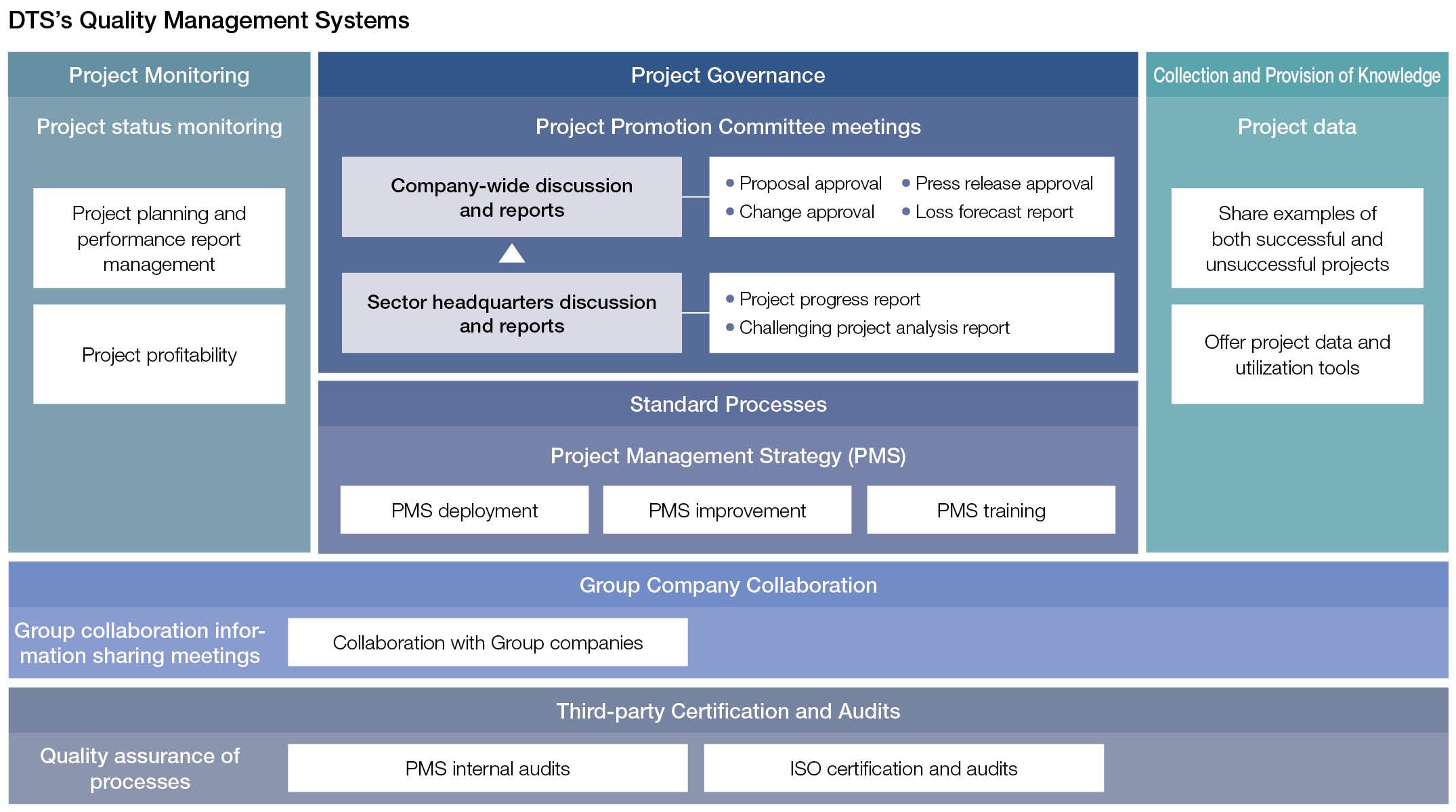
Main initiatives for quality control
- Project Governance
We have established project management meetings at the company-wide level (management) and the business unit level (department head) to oversee and supervise the content of proposals to clients, the appropriateness of project plans, sharing of project scope, risks, and challenges, and compliance with approved costs, depending on the scale and risk of the project.
- Process Promotion
We are implementing and improving DTS standard processes to enhance project productivity and quality. We also conduct training related to project management to share management directives and collected knowledge across the organization.
- Project Monitoring
We thoroughly prepare project plans and performance reports, conduct budget-versus-actual analysis on a project-by-project basis, and strive to improve productivity. We also monitor data such as project profitability forecasts to minimize unprofitable projects.
- Knowledge collection and provision
We collect, analyze, and provide project performance data. We also share company-wide information, such as the key success factors of highly productive (highly profitable) projects (as reported in management reports), and the results of problem project analysis reports (including cause analysis and preventative measures for unprofitable projects), through PMS training and project management meetings.
- Group company collaboration
We provide coordinated support for project governance and process operation to improve project management measures across our group companies. We also receive feedback from each company, aiming to mutually improve our project management capabilities.
- Third-party certification and auditing
To ensure and improve project quality, we objectively evaluate the processes implemented and deliverables created by the project from a third-party perspective.
Unprofitability Reduction and Quality Control Cycle
- Early identification of quality risks and continuous improvement
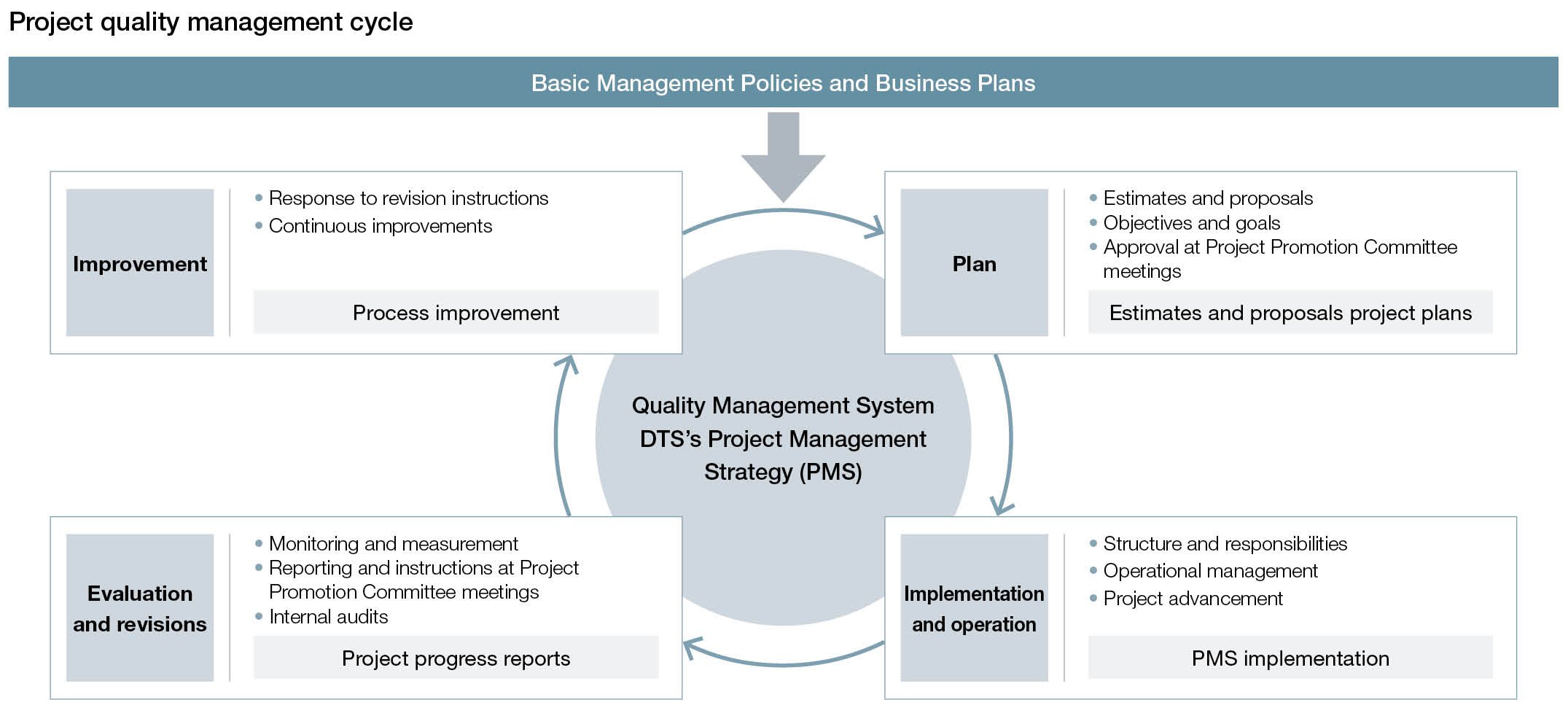
At the DTS Group, we continuously operate a cycle of planning, implementation/operation, evaluation/correction, and improvement based on our quality management system. Through project management meetings and internal audits, we confirm the progress, quality, and profitability of projects, and reflect the results in improvements to our standard process, PMS (Project Management Strategy). We analyze project implementation results, audit results, and customer feedback, and reflect these in process improvements and education/training to continuously enhance our quality control.
Furthermore, in order to prevent the occurrence of unprofitable projects and to bring them to an early conclusion, we monitor the projected sales, costs, and profits of each project on a monthly basis. If a loss is expected on a contract basis, we review the outlook from the perspectives of the situation, background, causes, impact, challenges and countermeasures, progress, quality, profitability, and staffing, and report and discuss it at the project management meeting according to the projected loss amount.
Furthermore, we are working to prevent unprofitable projects and thoroughly control damage by reviewing risks and reporting standards for each contract type and incorporating these into training for managers and management candidates. By continuously implementing these initiatives within the quality management cycle, we are contributing to stable business operations and continuous value delivery from both the perspectives of quality improvement and profitability management.
Developing project management personnel through education and training
- Improving project management skills through training
The DTS Group conducts training for managers and management candidates to establish the Product Management System (PMS), a standard process for quality control, and to improve project management capabilities. The training covers the basic concepts and operational rules of PMS, as well as profitability management, quality control, risk management, and case analysis of unprofitable projects. Furthermore, by incorporating case studies shared in project management meetings and lessons learned from past projects into the training content, the organization accumulates knowledge throughout, leading to the prevention of recurrence and improvement of management capabilities.
| Training name | the purpose |
|---|---|
| PMS Topics | Learning about PMS topics such as areas for improvement, recent trends in project management meetings, and case studies of unprofitable projects. |
| Project Management Measures and Understanding Check | This session aims to reinforce understanding by reviewing the overall picture of DTS's project management measures, understanding the latest improvements, and confirming key points through a test format. |
| PMS basics | Basic learning about PMS, including the necessity of the DTS standard process PMS and the structure of PMS. |
| Service provision | Understand the purpose and structure of the PMS, the overall flow of the operational process, and the required deliverables. |
| Risk management | Based on lessons learned from PMS risk cases, we will review risk management to prevent recurrence, understand the latest improvements, and establish risk management methods within DTS. |
| Project Plan | Based on lessons learned from risk cases stemming from project planning, we will review project planning and implement the latest improvements to prevent recurrence, and establish the methods for creating and utilizing plans within DTS. |
| quality management | This course will review "quality building and quality evaluation," understand the latest improvements, and solidify quality control methods, management techniques, and key points for quality evaluation. |
| Project Monitoring | Learning from risk incidents stemming from project monitoring, we will review project monitoring practices, understand the latest improvements, and solidify key points for project monitoring to enhance project evaluation capabilities. |
| Key points for the estimate | This article explains the overall process and key points of estimation in general system development, as well as tips for improving the validity of estimates. |
| Key points for offshore management | This article discusses the basic management flow and key points of bulk ordering for system development, and shares know-how unique to offshore development. |