
Promoting responsible supply chain management
The DTS Group considers collaboration with its business partners as a crucial foundation for its business activities, including system development, infrastructure construction, operation and maintenance, and BPO. We promote supply chain management with fair trade, quality and stable service delivery, information security management, compliance education and awareness, and respect for human rights as key management themes.
Our approach to supply chains
The DTS Group believes that collaboration with partner companies is essential for increasing added value. In April 2023, we established the "DTS Supply Chain Responsible Corporate Conduct Guidelines." In selecting partner companies, we adhere to these guidelines and prioritize partners who comply with laws and social norms, and who contribute to a sustainable society by considering human rights and the environment.
Guidelines for responsible business conduct in the DTS supply chain
The DTS Group has established "free competition and fair trade" as its core principles in the "DTS Group Code of Conduct" and is committed to ensuring strict adherence to them.
These guidelines outline the following points, for which we ask for your understanding and cooperation:
1. Compliance with laws and regulations and respecting international norms
In addition to complying with applicable laws and regulations in your home country and the countries/regions in which you operate, you must also respect international codes of conduct.
2.Human rights/labor
In addition to complying with relevant laws and regulations, we must also respect the human rights of workers by referring to international human rights standards, including the core labor standards set by the ILO (International Labor Organization).
(2-1) Prohibition of forced labor It is prohibited to use labor obtained through coercion, restraint, inhumane prison labor, slavery, or human trafficking.
It is also necessary to protect the right of workers to leave their jobs or terminate their employment voluntarily, without forcing them to work at all.
(2-2) Prohibition of child labor and consideration for young workers Children under the minimum working age must not be allowed to work. Furthermore, young workers under the age of 18 must not be engaged in hazardous work that may jeopardize their health or safety, such as night shifts or overtime.
(2-3) Consideration for working hours Workers must not be allowed to work beyond the limits stipulated by the laws and regulations of the region where they work, and workers' working hours and days off must be taken into account, taking into account international standards. must be managed appropriately.
(2-4) Appropriate Wages and Benefits Compensation paid to workers (including minimum wage, overtime pay, and legally mandated benefits and wage deductions) must comply with all applicable laws and regulations.
In addition, consideration should be given to paying wages at a level that can cover the necessities of life (living wage).
(2-5) Prohibition of inhumane treatment Respect the human rights of workers, and prohibit inhumane treatment such as mental and physical abuse, coercion, harassment, and any acts that may lead to such acts. Do not go to anyone.
You should also have facilities for storing your personal belongings and valuables, as well as a large enough personal space for proper access.
(2-6) Prohibition of discrimination There shall be no discrimination or harassment.
Additionally, requests from workers regarding religious practices must be considered to an appropriate extent.
(2-7) Freedom of association and collective bargaining rights After complying with local laws and regulations, it is necessary to respect the right of workers to organize as a means of achieving negotiations between labor and management regarding matters such as the working environment and wage levels.
3.Safety and health
In addition to complying with relevant laws and regulations, it is necessary to pay attention to ILO safety and health guidelines, etc., and take steps to minimize work-related injuries and mental and physical illnesses for workers and create a safe and sanitary work environment. .
(3-1) Occupational Safety It is necessary to identify and evaluate risks to occupational safety, and ensure safety through appropriate design, technology, and management measures.
Reasonable accommodations are required, especially for pregnant women and breastfeeding mothers.
(3-2) Prepare for emergencies In preparation for emergencies such as disasters and accidents that threaten human life and physical safety, identify the possibility of their occurrence and take emergency measures to minimize damage to workers and assets. It is necessary to create action procedures, install necessary equipment, and provide education and training so that the appropriate actions can be taken in the event of a disaster.
(3-3) Occupational Accidents and Illnesses It is necessary to identify, evaluate, record, and report the situation of occupational accidents and occupational diseases, and take appropriate countermeasures and corrective measures.
(3-4) Industrial Hygiene In the workplace, it is necessary to identify and assess the risk of worker exposure to harmful biological, chemical, and physical influences, and to manage them appropriately.
(3-5) Consideration for physically demanding work It is necessary to identify and evaluate physically demanding work and manage it appropriately to prevent occupational accidents and illnesses.
(3-6) Safety measures for machinery and equipment It is necessary to evaluate the machinery and equipment used by workers in the course of their work to see if there are any safety risks, and to implement appropriate safety measures.
(3-7) Facility Safety and Health It is necessary to appropriately ensure the safety and health of facilities provided for the lives of workers (dormitories, cafeterias, toilets, etc.).
Dormitories must also have adequate emergency exits.
(3-8) Safety and health communication Appropriate safety and health information education and training must be provided in words and methods that workers can understand regarding the various occupational hazards that workers may be exposed to.
Additionally, there is a need for a system to provide feedback on safety-related opinions from workers.
(3-9) Health management of workers Appropriate health management must be performed for all employees.
4.Environment
In addition to proactively addressing global environmental issues such as resource depletion, climate change, and environmental pollution, we must also consider local environmental issues to ensure the health and safety of the people in the communities involved.
(4-1) Environmental Permits and Reporting In accordance with the laws and regulations of the Head Offices of the business, it is necessary to obtain the necessary permits and approvals for the business, and perform registration and reporting.
(4-2) Reducing energy consumption and greenhouse gas emissions We must strive to improve energy efficiency and engage in activities to continuously reduce energy consumption and greenhouse gas emissions.
(4-3) Emissions into the atmosphere It is necessary to comply with related laws and regulations and implement appropriate measures to reduce emissions of harmful substances into the atmosphere.
(4-4) It is necessary to comply with water management laws and regulations, monitor the source, use, and discharge of water used, and save water.
All wastewater must be characterized, monitored, controlled and treated as appropriate before it is discharged or disposed of.
It is also necessary to identify potential sources of water pollution and take appropriate control measures.
(4-5) Promote reduce, reuse, and recycle resources by effectively utilizing resources, observing waste management laws and regulations, and conducting appropriate management. We need to make effective use of it and minimize waste generation.
(4-6) Comply with chemical substance management laws and regulations, identify, label, and manage chemicals and other substances that pose a danger to humans or the environment, and ensure safe handling, movement, storage, use, and Controls must be taken to ensure recycling or reuse and disposal.
(4-7) Management of chemical substances contained in products We must comply with all applicable laws, regulations and customer requests regarding prohibitions or restrictions on the use of specific substances contained in products.
5.Fair trade/ethics
In addition to complying with laws and regulations, we must conduct our business activities based on a high level of ethics.
(5-1) Preventing Corruption All types of bribery, corruption, extortion, and embezzlement must not be practiced.
(5-2) Prohibition of Providing and Receiving Improper Benefits Promises, offers, or permissions as means of obtaining bribes or other unfair or improper benefits must not be provided or accepted.
(5-3) Appropriate information disclosure Information regarding labor, health and safety, environmental activities, business activities, organizational structure, financial condition, and business results must be disclosed in accordance with applicable laws, regulations, and industry practices. Tampering with records or disclosing false information will not be tolerated.
(5-4) Respect for Intellectual Property It is necessary to respect intellectual property rights and transfer technology and know-how in a manner that protects intellectual property. You must also protect the intellectual property of third parties such as customers and suppliers.
(5-5) Conducting fair business Fair business, competition, and advertising must be conducted.
(5-6) Protection of whistleblowers It is necessary to protect the confidentiality of information related to reports and the anonymity of whistleblowers, and to eliminate retaliation against whistleblowers.
(5-7) Responsible Mineral Procurement Minerals such as tantalum, tin, tungsten, and gold contained in manufactured products are linked to serious human rights violations, environmental destruction, corruption, and conflicts in conflict-affected and high-risk areas. It is necessary to conduct due diligence to ensure that you are not causing or contributing to such incidents.
6.Quality/Safety
We must ensure the safety and quality of the products and services we provide, and provide accurate information.
(6-1) Ensuring product safety Products must meet the safety standards stipulated by the laws and regulations of each country, and must be designed, manufactured, and sold to ensure sufficient product safety, and fulfill our responsibilities as a supplier.
(6-2) Quality Control In addition to complying with all laws and regulations applicable to the quality of products and services, we must also comply with our own quality standards and customer requirements.
(6-3) Provision of accurate product and service information It is necessary to provide accurate and non-misleading information regarding products and services.
7. Information security
It is necessary to prevent the leakage of confidential and personal information and strengthen information security.
(7-1) Defense against cyber attacks It is necessary to take measures to protect against threats such as cyber attacks and manage them to prevent damage to your company and others.
(7-2) Protection of personal information All personal information of suppliers, customers, consumers, employees, etc. must be managed and protected appropriately in compliance with relevant laws and regulations.
(7-3) Preventing leakage of confidential information Confidential information received not only from your own company but also from customers and third parties must be appropriately managed and protected.
8.Business continuity plan
If your company or your business partners are affected by a large-scale natural disaster, you need to be prepared to resume production activities as soon as possible in order to fulfill your supply responsibilities.
(8-1) Formulation and preparation of a business continuity plan ( Business continuity plan ( It is necessary to formulate a business continuity plan (BCP).
April 2023
Supply chain management promotion system and operational processes
At the DTS Group, the business and project divisions are responsible for daily partner selection, outsourcing, and on-site management. The business promotion, sustainability promotion, and information security divisions support system operation by leveraging their respective expertise. This structure allows for integrated progress in contract and outsourcing verification, compliance education, respect for human rights, information security management, and continuous evaluation and improvement.
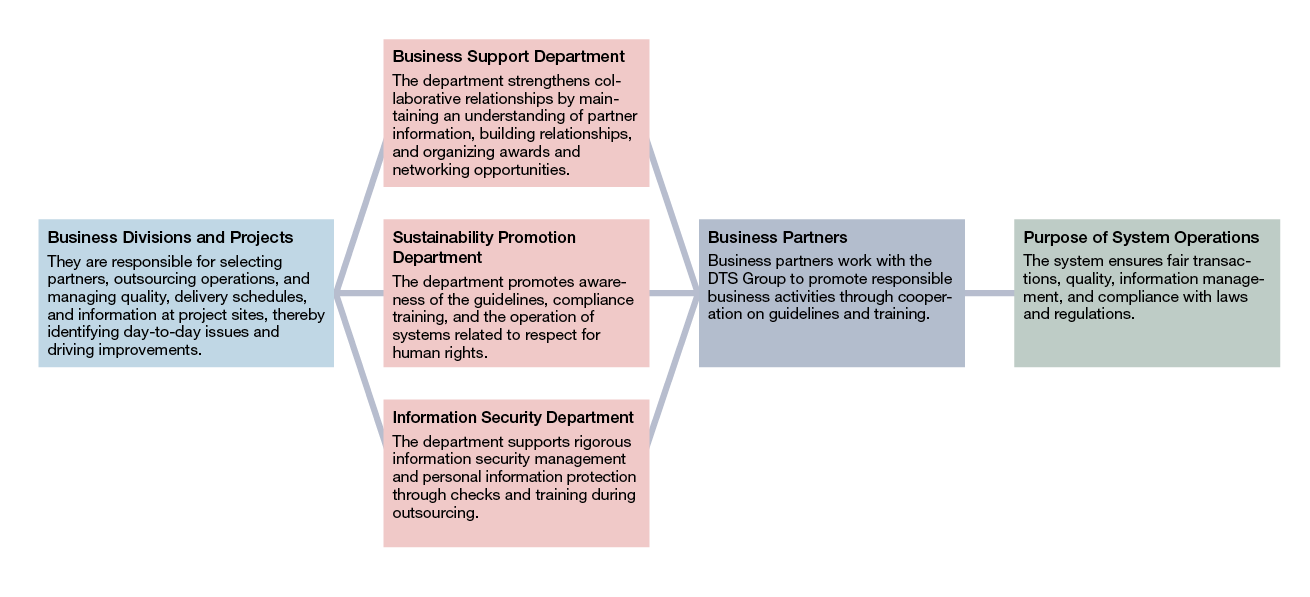
Operational Process

1. Selection and Contract
We assess our business partners' technical capabilities, quality, financial status, information security, compliance, etc., to determine whether or not to initiate business transactions. At the time of contract signing, we share the DTS Group's code of conduct and various rules to ensure a fair business relationship.
2. Sharing and agreeing on guidelines
Through the DTS Group Supply Chain Guidelines, we share our values regarding respect for human rights, legal compliance, information management, fair trade, and environmental considerations with our business partners. We confirm the status of agreements and work to build collaborative relationships based on common standards.
3.Education/Awareness
We share the compliance and information security principles that we expect from our DTS Group employees with our business partners. Through training and awareness campaigns, we are working to create a system where all stakeholders involved in a project share a common understanding and can thoroughly implement quality control, information management, and legal compliance.
4. Evaluation and Monitoring
Even after commencing business, we comprehensively review technical capabilities, quality, productivity, delivery time, financial status, and sustainability initiatives. Based on the evaluation results, we engage in dialogue and make requests for improvements as needed, aiming to maintain and improve our partnerships that lead to the stable provision of services.
5. Improvement and continuous dialogue
Based on evaluation results and challenges identified during projects, we engage in dialogue with our business partners to improve quality, information management, compliance, and other aspects. Through continuous communication, we strengthen collaborative relationships based on mutual trust.
supply chain
Fair trade
At the start of a transaction, we comprehensively verify technical capabilities, quality, price, service, legal compliance, etc., and conduct transactions based on an equal and transparent relationship. When concluding a contract, we conduct a self-inspection using a checklist for ensuring the proper conduct of contracted and entrusted work.
Quality and stable provision
In project management, the DTS Group is responsible for project management and quality control, and through sharing challenges with partner companies, we verify and improve quality and productivity.
Information security management
We require our contractors to maintain the same level of information security management as the DTS Group, and we conduct contractual checks, outsourcing checks, and ongoing education and awareness programs. When outsourcing work to partner companies, we also have regulations in place regarding the handling of personal information.
Compliance education and awareness
We also ensure that employees of our partner companies are aware of our code of conduct, workplace rules, and helpline, and we strive to prevent compliance incidents through training at the start of new projects and verification of training records.
Respect for human rights
Based on these guidelines, we ask for your understanding and cooperation regarding the prevention of discrimination and harassment, proper management of working hours, and occupational safety and health. For details on our basic approach and initiatives regarding human rights, please refer to the DTS Group Human Rights Policy.
Supply chain evaluation
The DTS Group conducts an annual "Supply Chain Evaluation" for new business transactions and partner companies with whom contracts are ongoing. In addition to technological capabilities, quality, productivity, delivery time, and financial status, the evaluation comprehensively assesses sustainability initiatives using various indicators. Furthermore, the group regularly checks for the names of companies publicly disclosed for legal violations to confirm whether or not they are still doing business with the group.
Relationships with business partners
Partner companies' support is indispensable to the advancement of DTS's business. Every year, we select award recipients at the business unit level and recognize partner companies that have made significant contributions to our business. We also hold an annual partner meeting, which consists of an informational session introducing our business content and business policies, and a social gathering to foster interaction with partner companies. We also aim to expand business opportunities through post-event surveys.